

Health and Medical History of President
Ronald Reagan
President #40: 1981-1989
Lived 1911-2004
Lived 1911-2004
"He forgot the names of Cabinet officers, trusted aides and visiting
dignitaries. In Brazil, he toasted the people of Bolivia."
1

Health and Medical History of President
Ronald Reagan
President #40: 1981-1989
Lived 1911-2004
Lived 1911-2004
↓


 Lived 1911-2004
2023
1776
Lived 1911-2004
2023
1776
 Revolutionary War1776-1783
War of 18121812-1815
Mexican-American War1846-1848
Civil War1861-1865
Spanish-American War1898-1899
World War 11917-1918
World War 21941-1945
Korean War1950-1953
Viet Nam War1964-1975
Desert Storm1990-1991
Bush's Wars2001-2021
Revolutionary War1776-1783
War of 18121812-1815
Mexican-American War1846-1848
Civil War1861-1865
Spanish-American War1898-1899
World War 11917-1918
World War 21941-1945
Korean War1950-1953
Viet Nam War1964-1975
Desert Storm1990-1991
Bush's Wars2001-2021
Lived 1911-2004
2023
1776
Revolutionary War1776-1783War of 18121812-1815Mexican-American War1846-1848Civil War1861-1865Spanish-American War1898-1899World War 11917-1918World War 21941-1945Korean War1950-1953Viet Nam War1964-1975Desert Storm1990-1991Bush's Wars2001-2021
"He forgot the names of Cabinet officers, trusted aides and visiting
dignitaries. In Brazil, he toasted the people of Bolivia."
1
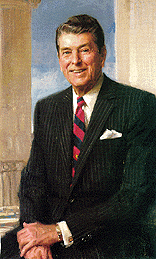
Maladies & Conditions
· birth & childhood · severely nearsighted · pneumonia · femur fracture · quit smoking · prostate stones · severe cold · TMJ degeneration · thumb arthritis · drank little · chronic hay fever · general health · height · blood type O-positive · shot · hearing aids · dyed hair · exercised · colon cancer · colonic polyps · skin cancer · chainsaw laceration · prostate enlargement · gastroenteritis · Alzheimer harbingers · Alzheimer disease · adhesions · bleed · hip fracture · pneumonia
Odds & Ends ·
Doctors ·
Resources ·
Cited Sources
Maladies and Conditions

Reagan's birth was long and difficult (to a degree that his mother was advised not to have
more children
1.)
He weighed 10 pounds at birth. In that era of high infant mortality, Reagan's father bragged
about his fat little "Dutchman" and the name stuck
2a.
"Apparently, in spite of the rather stark poverty of his family, Reagan's childhood
was almost free of illness"
2a.

He was so nearsighted that, as a college football player, his vision was limited to the square
yard of turf occupied by the opposing team's guard. His vision disqualified him from serving
in combat units in World War II
2b.
As a child, Reagan would have to sit in the front row in class to see, which embarassed
him. In sports, Reagan sometimes got hit in the head with the ball he could not see. It was
only at age 9 or 10 that a visiting nurse made the diagnosis. Reagan later said that when he
got glasses, he was surprised to discover that trees had leaves and that butterflies existed
-- neither of which he had ever been able to see
3.
Later in life, Reagan wore contact lenses. When delivering a speech he would remove one
lens so he could read his notes and leave one lens in so he could see the audience. Thus, for
those around Reagan it was common practice to see him re-inserting a contact lens after speaking
3.


Pneumonia in 1945 caused him to lose 17 pounds
4.
Comment:
The reference does not say whether antibiotics -- still very scarce in 1945 -- were used. Given
the severity of the episode, Dr. Zebra suspects not.


Reagan fractured a femur in 1949. A "serious fracture," it may have resulted from
falling off a horse
5.


After a series of urinary tract infections, Reagan had prostate stones surgically removed in
1966. "Since the surgery he's had no problems at all." For many years afterwards
Reagan had regular check-ups from a urologist in Santa Monica
5.
Another reference
8
says
Dr. T. Burton Smith
performed a trans-urethral prostatectomy on Reagan in 1967, presumably because of his history
of "well-documented benign prostatic hypertrophy and several episodes of prostatitis."
Thus, it is unclear if Reagan had one or two urological operations in the 1960s. (Probably
one.)
About 1978 Reagan had a severe cold that required antibiotics. A chest X-ray was taken because
the cold went to his chest. The X-ray was normal
5.

Reagan presented with left-sided jaw pain in December 1977. It proved to be degeneration of
the temporomandibular joint, and was treated with cortisone injection. It did not recur in
the next 3 years
5.
Reagan had osteoarthritis of the proximal thumb joint on his right hand. As of 1980, he was
not taking medication for it
5.

Reagan was reported to drink very little alcohol. His favorite cocktail was "a weak orange
blossom"
2c.
Reagan underwent hyposensitization shots for hay fever, and may still have been getting "maintenance"
injections at the time of his 1980 election. With this course, his hay fever "was under
control." He did not have adverse effects from the shots.
5.
At the time, Reagan was the oldest man ever to seek the Presidency. Thus, there was concern
during his campaigns whether his health was up to the job. He sought to downplay these concerns
by vowing to resign the Presidency if he became medically unfit
7.
He also authorized the release of information about his medical history.
Quotes from the
primary
5
of his six
7
physicians include:
(1) He is in excellent health. He just underwent a strenuous campaign and had no problems whatsoever.
His resistance to colds was remarkable. (2) He exercises every day with a wheel device and
rides horseback at his ranch whenever he can. ... It's a single small wheel -- such as you
might see on a kid's wagon -- to which two handles are attached. (3) I think he is quite able
to handle stress. ... He doesn't take vacations very frequently. (4) I know he eats moderately,
and we've told him he should avoid excessive amounts of animal fats and carbohydrates. (5)
The standard treadmill tests [have shown] no evidence whatsoever of underlying coronary artery
disease. We have also found no evidence of any neurological impairments. (6) When I have done
different physical examinations on him, ... he's totally relaxed and undemanding. He goes through
those tests in a place that is especially set up for him and where he could pull rank but he
doesn't. ... He just accepts the fact that we're doing all these tests. He doesn't ask many
questions. (7) [The article also included comments about conditions noted elsewhere on this
web page.]


Both Ronald and Nancy Reagan are O-positive
10a.
Reagan was shot on March 30, 1981. A long-nosed .22 caliber bullet, fired from a pistol, ricocheted
off the Presidential limosine and entered Reagan's chest, under his left arm. The bullet was
of the exploding type, but it did not explode. The main threat to Reagan's life was from blood
loss and a collapsed lung
2d.
After entering Reagan's body, the bullet ricocheted off his left-sided seventh rib. By
now the bullet was deformed into a dime-shaped mass, and when it entered Reagan's left lung,
it did considerable damage to the lung tissue. The lung began bleeding, and collapsed. The
bullet lodged about one inch from the heart.
To see the full chronology of events, click here:
MORE
The first-line treatment for a collapsed lung is a chest tube -- a plastic tube that is
inserted through the skin, between the ribs, and into the chest cavity where the lungs sit.
This is not a difficult procedure, and medical students are often allowed to insert a chest
tube (under supervision) after having seen just once how to properly do it. Dr. Zebra was told
that a medical student at the George Washington University School of Medicine, doing a rotation
in the emergency room, had earlier that day seen a chest tube inserted. Furthermore, the resident
supervising the student told him, "OK, you get to put in the chest tube on the next case
that comes in." Shortly thereafter, an ashen Reagan walked through the door and collapsed.
The resident immediately looked at the student and said: "No!"
11.
It has been noted that Reagan's wound was, at the outset, "much more life-threatening
than that of
Garfield
or
McKinley,
who would both have almost certainly survived" had modern surgical care been available
to them
2e.
Throughout the episode, the President's staff was, in the words of Reagan's physician,
Dr. Daniel Ruge,
"anxious to portray the president as being well. ... But nobody is very well after being
shot, and having had an anesthetic, and having lost a lot of blood and having it replaced"
10b.
(Reagan lost over half of all the blood in his body
10c.)
Ruge felt that Reagan did not recover completely until October, i.e. 6-7 months after the shooting
10b.
Former aide Michael Deaver says Reagan became more stubborn after the shooting. Reagan
believed that he was "chosen" for his role by a higher power, and that the shooting
was a reminder of this. He therefore decided to more closely follow his own instincts
3.

It has been speculated that Reagan's hearing loss, and eventual use of hearing aids bilaterally,
was caused by exposure to gunshot noise while filming numerous Western movies in Hollywood
2c.
At the time of his 1980 election, the hearing loss was described as "moderate"
5.
The hearing loss may have been asymmetric to some degree. Reagan's chief of staff, Donald Regan,
once tried to deliver a message to Reagan during a press conference, "but Reagan could
not hear since Regan was talking into Ronald's deaf ear"
2f.
Reagan was fitted with a $1000 custom-made hearing aid in 1983
4.
How can a 70 year old man have a full head of hair with no gray?
The answer comes from
Gerald Ford's
observation that "Ronnie doesn't dye his hair, he's just prematurely orange," referring
to the fact that "Orange on a middle-aged man means he's been playing unsupervised among
the Clairol"
12.

Reagan worked out "about 5:00 or so each afternoon, or when the work was done," for
an hour or more in a White House bedroom that had been converted into a gym with exercise equipment.
He would then take a bath
2c


A 1984 proctoscopic examination disclosed a small polyp in Reagan's colon. Biopsy showed it
was benign. In March 1985, another polyp was found, as were trace amounts of blood in his stool.
A change in Reagan's diet eliminated the blood. He underwent endoscopic removal of the polyp
and colonoscopy on July 12, 1985, at Bethesda Naval Medical Center. Colonoscopy disclosed a
second, more dangerous tumor -- a villous adenoma -- that could only be removed by surgery.
10d
Although Nancy Reagan apparently preferred to delay surgery until the following week on
the advice of her astrologer, Reagan preferred to have the surgery the next day -- to avoid
having to repeat the colonic preparation
10e.
The operation lasted 2 hours and 53 minutes. The right-sided portion of Reagan's colon
was removed -- about 2 feet of length. Exploration of other abdominal structures found no spread
of the cancer. The tumor was ultimately classified as a "Duke's B," meaning
it had invaded the muscle of the colon, but was confined to the bowel wall
10f
Post-operatively, one of the surgeons remarked about the then-74-year-old President: "This
man has the insides of a forty year old"
2g.
Reagan left the hospital on July 20
13.
As a result of the surgery, Reagan transferred Presidential power to Vice President
Bush
for 7 hours and 50 minutes
MORE
10g.
It is often written that Reagan invoked
section 3
of the
25th Amendment
to make this transfer, but he did not explicitly invoke the Amendment
10h.
Reagan had CAT scans every six months after his 1985 cancer surgery. It is not clear whether
one of these scans or another test discovered two polyps in Reagan's colon in 1987. The polyps,
said by his physician,
Dr. John E. Hutton,
to be small and apparently benign, were removed during colonoscopy at the White House on July
28, 1987
2h.
Comment:
The date may not be exactly correct.

A small basal cell carcinoma (a type of skin cancer) was removed from Reagan's nose on July
31, 1987. Later, a larger area of tissue surrounding the lesion was excised, under local anesthesia
at Bethesda Naval Hospital
2h.
Comment:
The date may not be exactly correct.
Another basal cell carcinoma was removed from his neck in 1995
4.
Dr. John Hutton
recalled encountering Reagan at the Reagans' California ranch (this seems to have been during
the Presidency): "He smiled, reached up and grabbed my hand. Then I noticed he had a big
hole in his dungarees, and there was blood all around it. He was out with his chain saw and
he had cut his thigh. If he'd gone another inch, he might have hit a big artery, but it was
a glancing blow."
14.
Underwent transurethral prostate surgery in November 1987 because of benign prostatic hypertrophy.
The procedure went smoothly
2h.
Also:
15a.
Had (perhaps) previously undergone the same operation in 1967 (see above)
8.
"The Cold War began to end when two elderly gentlemen discovered that they shared
a common difficulty with their bladders." Soviet foreign minister Andrei Gromyko was at
the White House. Reagan was supposed to raise one crucial, secret issue when the two were alone.
Security people watched Reagan and Gromyko alone in the Oval Office, nodding in conversation.
Afterwards, US State Department people asked the Soviets for their reaction to the secret issue.
The Soviets looked blank. What secret issue? "Reagan, 73, had asked Gromyko, 75, only
if he would like to use the private Presidential lavatory. Indeed Gromyko would. Very much.
He went first. Reagan went second. They washed their hands and, much relieved, the two old
fellows strolled in to lunch. Arms control was forgotten, but a certain rapport had been forged
among the faucets."
16a

Recovering from being shot (three months into his presidency), Reagan became disoriented in
the intensive care unit. His physicians, therefore, pressed to have him moved to a hospital
suite
10i.
Comment: In retrospect, this was probably a sign of Reagan's slipping mentation... yes, Dr. Zebra is aware of the many reasons people get disoriented in an ICU, but let's face it, it does not often happen to 40 year olds. This is especially true given a physician's statement that during Reagan's recovery "He always had a high pain threshold and required only small amounts of pain medication" 8a. Comment: It is unclear how much brain power is needed to be a successful chief executive. This is certainly true in large corporations, as Dr. Zebra heard many times during his medical training, from professors who had taken care of CEOs who were demented, yet still working. Thus, Gerald Ford's assessment is relevant: "He was not what I would [call] a technically competent president. You know, his knowledge of the budget, his knowledge of foreign policy -- it was not up to the standards of either Democrat or Republican presidents. But he had a helluva flair.... So I praise his assets, but I have reservations about his technical ability" 17a. Reagan's mother was "senile" for "a few years" before she died of atherosclerotic disease at age 80 7.
Comment: In retrospect, this was probably a sign of Reagan's slipping mentation... yes, Dr. Zebra is aware of the many reasons people get disoriented in an ICU, but let's face it, it does not often happen to 40 year olds. This is especially true given a physician's statement that during Reagan's recovery "He always had a high pain threshold and required only small amounts of pain medication" 8a. Comment: It is unclear how much brain power is needed to be a successful chief executive. This is certainly true in large corporations, as Dr. Zebra heard many times during his medical training, from professors who had taken care of CEOs who were demented, yet still working. Thus, Gerald Ford's assessment is relevant: "He was not what I would [call] a technically competent president. You know, his knowledge of the budget, his knowledge of foreign policy -- it was not up to the standards of either Democrat or Republican presidents. But he had a helluva flair.... So I praise his assets, but I have reservations about his technical ability" 17a. Reagan's mother was "senile" for "a few years" before she died of atherosclerotic disease at age 80 7.
At one time Reagan "possessed a remarkable memory that his brother described as photographic"
1.
Soon after graduating from college, he auditioned for a sports announcer job by "re-creating
the fourth quarter of a Eureka College football game from memory"
1.
(Reagan had played in the game.)
As an actor, "much of Reagan's early career was spent in the B-film division, where his
knack for quick memorization made him a valuable asset. Producers of B-films, as Reagan often
put it, 'didn't want them good, they wanted them Thursday'"
1.
By contrast, as President, in his 70s, "He forgot the names of Cabinet officers, trusted
aides and visiting dignitaries. In Brazil, he toasted the people of Bolivia"
1.
A friend tells Dr. Zebra of a film clip in which Reagan, as President, is asked a question,
only to look completely blank until the camera audio picks up his wife Nancy whispering an
evasive answer ("We're doing all that we can") into Reagan's ear, which he then speaks.
In 1993 Reagan became increasingly forgetful. Alzheimer disease was diagnosed during his
annual visit to the Mayo Clinic in 1994. His condition was announced to the public in a carefully
worded letter to the American people on Nov. 5, 1994
1
MORE
According to
Gerald Ford,
Reagan was stll able to write a letter the week of the public announcement, but by 1995
he did not recognize people and a 24-hour nurse for him was being sought
17b.
Ford also said that he visited Reagan in Century City (Reagan's office) in January 1999, but
Reagan did not recognize him at all, despite Ford's best efforts
17c.
Comment:
The 1995 and 1999 accounts seem to be at odds over the progression of the disease.
There is an interesting photograph of Reagan, taken in 1996, that shows a visible sign
of his Alzheimer disease
MORE
. He is shown standing with a model of the U.S.S. Ronald Reagan, a ship named in his honor,
along with his wife and the CEO of the company building the ship. Reagan's necktie peeks out
below the button of his suit coat. Reagan was extremely careful with his appearance all his
life -- as an actor and as a President who wore $1000 suits -- so this tiny slip is actually
significant, as a sign of inattention caused by his disease. (For a case in which this sign
was actually responsible for the diagnosis of Alzheimer disease in a business executive, see
18a.)
Was Reagan symptomatic while in office? There was speculation about his mental function
as early as 1987, just after he underwent his third major operation while in office (prostate).
In response, Reagan held a press conference on March 19, 1987 in which he performed extremely
well in front of a hostile press
15a.
Gerald Ford
visited Reagan when the disease was well advanced. "He barely recognized me. . . I tried
to bring up things that would refresh his memory, but he was not the Ronald Reagan that I [had
known]"
17d.
Required "surgeries to eliminate scar tissue" that developed as a result of the 1985
colon cancer operation. In 1990 additional scar tissue forced postponment of a planned trip
to Europe
4.
Comment:
"Scar tissue" undoubtedly refers to adhesions.
Epidural hematoma after falling off a horse while vacationing in Mexico. Underwent neurosurgery
at the Mayo Clinic in Rochester, MN
4.
Reagan fell at his home on January 12, 2001, breaking his hip. He was taken by ambulance to
St. John's Health Center in Santa Monica, CA. On the morning of January 14,
Dr. Kevin Ehrhart,
led the surgical team that "inserted metal pins and screws into Reagan's hip." Dr.
Ehrhart expected that Reagan's recovery would be complicated by coexisting Alzheimer disease.
19

Died of pneumonia on June 5, 2004
20.
Comment:
Pneumonia is a frequent complication of Alzheimer disease. Reflexes which normally prevent
aspiration of mouth contents into the lungs may be lost or severely diminished in Alzheimer
disease. The lungs are normally sterile, so this introduction of infectious agents into the
lungs can lead to pneumonia. Aspiration pneumonia can be difficult to treat.
Odds and Ends
- Reagan's father was alcoholic ("the Irish curse") and smoked three packs of cigarettes a day. He died of a heart attack at age 60 7. Reagan's mother almost died in the 1918 influenza pandemic. 2a His elder daughter, Maureen (by his first wife), died of malignant melanoma in 2001 4.
- Dr. John Hutton felt Reagan, as a patient, "was just so compliant and considerate. It was a pleasure working for him 14.
- Doubtlessly influenced by her husband's Alzheimer disease, Mrs. Reagan called for increased funding for stem cell research shortly before his death 4, a position at odds with that of the Republican president then in office.
Doctors
Before Presidency
During Presidency
Assassination Attempt
After Presidency
Resources


Cited Sources
- Cannon, Lou. Actor, Governor, President, Icon. Washington Post. 6 June 2004, page A1. Available on the web at: https://www.washingtonpost.com/archive/politics/2004/06/06/actor-governor-president-icon/3a46fbaa-a322-4cae-9439-d461bb23a53e/
- Bumgarner, John R. The Health of the Presidents: The 41 United States Presidents Through 1993 from a Physician's Point of View. Jefferson, NC: MacFarland & Company, 1994.
 a p.281 b pp.281-282 c p.282 d pp.282-283 e p.283 f p.282, citing page 318 of Donald Regan's book For the Record. g p.285 h p.286 i pp.286-287Comment: Devotes one chapter to each President, through Clinton. Written for the layperson, well-referenced, with areas of speculation clearly identified, Dr. Zebra depends heavily on this book. Dr. Bumgarner survived the Bataan Death March and has written an unforgettable book casting a physician's eye on that experience.
- Deaver, Michael. [Interview]. Charlie Rose Show. KQED-TV, San Francisco, 14 June 2004.
- Anonymous. Reagan legacy includes raising awareness of several diseases. Associated Press / CNN. 8 June 2004, 1:49 pm EDT.
Comment: Available on the web at: http://www.cnn.com/2004/HEALTH/06/05/reagan.health.ap - Reynolds, John. How healthy is Reagan?. U.S. News and World Report. 8 Dec. 1980; pages 25-26.
Comment: An interview with Dr. Reynolds. - Boller, Paul F. Jr. Presidential Anecdotes. New York: Oxford University Press, 1981.
 a p.354
- Altman, Lawrence K. Reagan vows to resign if doctor in White House finds him unfit. New York Times. 11 June 1980; A1, A28.
Comment: All the information from this article is not yet posted here. - Beahrs, Oliver H. The medical history of Ronald Reagan. Journal of the American College of Surgeons. 1994; 178: 86-96. Pubmed: 7512407.
a p.90Comment: Dr. Zebra has not checked the correspondence about this article that appeared as J Am Coll Surg. 1994 Dec;179(6):763; author reply 763-4 (Pubmed 7952492 and 7952493).
- Page, Susan. Time-tested formulas suggest both Bush and Kerry will win on Nov. 2. USA Today. June 23, 2004.
Comment: Accessed through usatoday.com: http://www.usatoday.com/news/politicselections/nation/president/2004-06-23-bush-kerry-cover_x.htm - Abrams, Herbert L. "The President Has Been Shot": Confusion, Disability, and the 25th Amendment in the Aftermath of the Attempted Assassination of Ronald Reagan. New York: W. W. Norton & Company, 1992.
 a pp.59-60 b p.74 c p.64 d pp.197-198 e p.198 f p.202 g p.204 h pp.199-201 i p.67Comment: Rigorous and enormously thought provoking. Abrams tells not only the story of the shooting itself, but, more importantly, the maneuvering to disguise Reagan's slow recovery afterwards and forestall any consideration of transferring power to the Vice President.
 - Zucker, Howard. Personal communication. Baltimore, Maryland. circa 1987.
Comment: Zucker was in the emergency room at GW that day. - Heimel, Cynthia. Combover Congress: how can we trust our leaders to manage impeachment when they can't even manage their hair?. Salon.com. Feb. 3, 1999.
Comment: Caveat emptor: no written source for these statements is known to Dr. Zebra. Available on the web at: http://www.salon.com/news/1999/02/03newsb.html - Available on the web: http://www.reagan.utexas.edu/archives/speeches/1985/71385b.htm
Comment: This letter is deposited in the Ronald Reagan Presidential Library. The online version of the letter has been incorrectly annotated by the Library staff to underplay the seriousness of the condition Reagan had. The annotation says the operation was to remove a polyp, when it was actually to remove a malignant cancer well past the polyp stage. - Hedger B. White coats in the White House: Former presidential physicians reflect on their service. AMedNews. Mar. 23, 2009.
Comment: http://www.amednews.com/article/20090323/profession/303239973/4/ - MacMahon, Edward B. and Curry, Leonard. Medical Cover-Ups in the White House. Washington, DC: Farragut, 1987.
 a p.3
a p.3
- Walker, Martin. The Cold War. New York: Henry Holt, 1995.
 a pp.288-289
- DeFrank, Thomas M. Write It When I'm Gone: Remarkable Off-the-Record Conversations with Gerald R. Ford. New York: G.P. Putnam's Sons, 2007.
 a p.114 b p.118 c p.119 d p.108
 - Alvarez, Walter C. Nervousness Indigestion and Pain. New York: Paul B. Hoeber, 1943.
a pp.100-101
- Sanchez, Rene. Reagan recovering at hospital after surgery. Washington Post. 14 January 2001, page A2.
- Anonymous. Reagan to be honored with state funeral. Associated Press / Chicago Tribune. 6 June 2004, 6:57 CDT.
Comment: Available on the web at: http://www.chicagotribune.com/news/nationworld/bal-funeral0606,1,2596318.story
 85 reviews
Other Sources
George Washington · John Adams · Thomas Jefferson · James Madison · James Monroe · John Q. Adams · Andrew Jackson · Martin van Buren · William Harrison · John Tyler · James Polk · Zachary Taylor · Millard Fillmore · Franklin Pierce · James Buchanan · Abraham Lincoln · Andrew Johnson · Ulysses Grant · Rutherford Hayes · James Garfield · Chester Arthur · Grover Cleveland · Benjamin Harrison · Grover Cleveland · William McKinley · Theodore Roosevelt · William Taft · Woodrow Wilson · Warren Harding · Calvin Coolidge · Herbert Hoover · Franklin Roosevelt · Harry Truman · Dwight Eisenhower · John Kennedy · Lyndon Johnson · Richard Nixon · Gerald Ford · James Carter · Ronald Reagan · George Bush · William Clinton · George W. Bush · Barack Obama · Donald Trump · Joseph Biden