

Health and Medical History of President
Abraham Lincoln
President #16: 1861-1865
Lived 1809-1865
Lived 1809-1865
"He may be President of the United States, but he has dirty fingernails."
1a

Health and Medical History of President
Abraham Lincoln
President #16: 1861-1865
Lived 1809-1865
Lived 1809-1865
↓


 Lived 1809-1865
2023
1776
Lived 1809-1865
2023
1776
 Revolutionary War1776-1783
War of 18121812-1815
Mexican-American War1846-1848
Civil War1861-1865
Spanish-American War1898-1899
World War 11917-1918
World War 21941-1945
Korean War1950-1953
Viet Nam War1964-1975
Desert Storm1990-1991
Bush's Wars2001-2021
Revolutionary War1776-1783
War of 18121812-1815
Mexican-American War1846-1848
Civil War1861-1865
Spanish-American War1898-1899
World War 11917-1918
World War 21941-1945
Korean War1950-1953
Viet Nam War1964-1975
Desert Storm1990-1991
Bush's Wars2001-2021
Lived 1809-1865
2023
1776
Revolutionary War1776-1783War of 18121812-1815Mexican-American War1846-1848Civil War1861-1865Spanish-American War1898-1899World War 11917-1918World War 21941-1945Korean War1950-1953Viet Nam War1964-1975Desert Storm1990-1991Bush's Wars2001-2021
"He may be President of the United States, but he has dirty fingernails."
1a
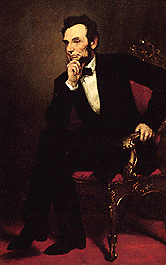
Maladies & Conditions
· Introduction · MEN 2B · not color blind · near-drowning · concussion · clubbed in head · axe cut · malaria - 1830 · frostbitten feet · malaria - 1835 · syphilis · blood type A · marfanoid habitus · pectus excavatum · pseudo-depression · vertical strabismus · presbyopia · jaw fracture · penetrating voice · swollen feet · scarlet fever? · domestic violence · asymmetries · premature aging · face, neck, beard · corns · constipation · food poisoning · dentist phobia · cancer · Willie's death · pulsations · smallpox · strong · receding hairline · gas leak · upset stomach · assassination & resuscitation
Odds & Ends ·
Doctors ·
Resources ·
Cited Sources
Maladies and Conditions

Dr. Zebra has written two books about the medical history of President Lincoln and his family
2
3.
In the process, he examined several hundred primary source documents which, surprisingly, turned
out to be a highly disturbing experience, when it became clear that both historians and physicians
had deeply corrupted this material in their writings over the years. Plainly stated, much
of what appears in print about Lincoln -- and much of what people believe about his medical
status -- is incorrect. For example:
- There is no evidence that Lincoln was color blind.
- There is no evidence that Lincoln had sore feet.
- There is essentially no evidence that Lincoln was depressed, and strong evidence against it.
- The claims that Lincoln had end-stage valvular heart disease are not tenable.
- There is no evidence that Lincoln or his father had type 5 spinocerebellar ataxia (SCA5), with strong evidence against it.
- The evidence that Lincoln had Marfan syndrome is weak.
- The conclusion that Lincoln had hemifacial microsomia is wrong.
- and, slightly off-topic, Photographs clearly show that Tad Lincoln did not have a cleft lip.



A 2008 book by Dr. Zebra proposes that Lincoln
and several of his family members had a hereditary cancer syndrome called multiple endocrine
neoplasia, type 2B (MEN2B)
2.
The diagnosis strongly suggests that Lincoln was dying of cancer in his last months, and
also explains many previously mysterious Lincolnian characteristics:
- Lincoln's body shape, i.e. his height, long limbs, big feet, leanness, high voice, flat feet, sunken chest.
- Lincoln's sagging face, that witnesses mistakenly thought was sadness or depression.
- Lincoln's bumpy lips and big lower lip.
- The large bump on Lincoln's right cheek.
- Lincoln's fatigue, headaches, fainting, and cold hands & feet in his last months.
- Lincoln's intermittently drooping eyelids.
- Lincoln's constipation.
- Lincoln's high voice.
- Lincoln's propensity to lie on the floor when reading, and rest his feet on a table when sitting.
- Lincoln's asymmetric face and homeliness.
- Lincoln's loose-jointedness.
- The death of three of Lincoln's sons before age 20, and, probably, his mother's death at 34.

For many years Dr. Zebra reported, as have several others, that Lincoln was color blind. Recently,
however, he reviewed the original evidence behind this assertion (Thomas Shastid's 1929 article
in The Nation) and found it completely worthless. There is no good reason to believe
Lincoln had defective color vision
3a.

As a child Lincoln almost drowned in Knob's Creek, Kentucky. A neighbor boy saved him.
4a
Austin Gollaher ... claims to have saved Lincoln from drowning one day as they were trying to 'coon it' across Knob Creek on a log. The boys were in pursuit of birds, when young Lincoln fell into the water, and his vigilant companion ... fished him out with a sycamore branch. 5a
At age 9, Lincoln was driving an old horse in a grist mill. Impatiently, he applied the whip
and was rewarded with a kick square to the forehead. He was unconscious for several hours,
and there were fears for his life. The kick came at a moment when Lincoln was halfway through
speaking a sentence. Remarkably, his first words upon regaining consciousness were the completion
of the sentence
5
3b.
Returning from New Orleans in 1828 by boat, Lincoln and a companion were attacked in their
sleep by seven men, "with intent to kill and rob them." As Lincoln emerged from a
hatchway, an attacker "struck him a blow with a heavy stick ... making a scar which he
wore always"
3c.
Lincoln almost took off his thumb with an axe, according to a 20-year-old memory from sculptor
Leonard Volk. However, a high resolution print of a
photograph
shows a wide linear scar over Lincoln's left forefinger
2a.

Lincoln's father moved the family to Macon County, Illinois in 1830. All of the family members
developed "ague and fever" that autumn -- probably vivax malaria. They treated it
with Peruvian bark and whiskey, and resolved to leave the area
3d.
(Peruvian bark contains quinine, which is an effective anti-malarial.) Lincoln, having reached
the age of 21, settled in New Salem, IL.
During the famous "deep snow" winter of 1830-1831, still remembered even 100 years
later, Lincoln's feet were badly frozen while crossing the Sangamon River. He was marooned
for weeks in the cabin belong to the Warnick family. Mrs. Warnick treated Lincoln by putting
his feet in the snow, "to take out the frost-bite"
6a
3e.
The hot summer of 1835 in New Salem, IL followed a wet spring -- perfect conditions for malaria.
Lincoln had chills and fever on alternate days (i.e. malaria) for at least a month, and took
"heroic doses" of quinine and cathartics, but irregularly
2b
3f.
Then his near-fiancee Ann Rutledge died of "brain fever" (perhaps typhoid). Claims
that this triggered an episode of major depression in Lincoln
7
rest on incomplete analysis of the historical record. A neighbor couple treated the bereaved
Lincoln, who returned to work no later than three weeks after Rutledge's death
2b
3f.
Lincoln's law partner, William Herndon, wrote that Lincoln had syphilis about 1835-1836. Herndon
said Lincoln told him this. Long known to Lincoln scholars, this topic erupted into public
debate in the 1980s because many historians did not believe Herndon, while the writer Gore
Vidal did. Dr. Zebra's full discussion
3g
finds no reason to disbelieve Herndon, and finds many reasons to believe him.

Lincoln was 6 feet 3.75 inches tall, had long legs, long arms, long thin feet, long hands,
a long thin face, a long thin neck, flat feet, and a "sunken breast" (in the words
of his law partner William Herndon)
2c.
All of these characteristics are typical of persons with Marfan syndrome
9.
This does not mean Lincoln had Marfan syndrome, however. More than a dozen different medical
conditions cause this same type of body shape; Lincoln had one of these other disorders (MEN
2B). Still, it is proper to say that Lincoln was "marfanoid," meaning he was shaped
like a person with Marfan syndrome.
For his time, Lincoln was about 7.5 inches taller than average
2d.
His height came from his legs. Sitting, he was no taller than the average man
2e.
(See photo.)
It has been said that a cast of Lincoln's hands show them to be muscular and powerful,
not the slender hands of Marfan syndrome
10
11.
This is not correct. True, the casts show that Lincoln did not have the classic long, graceful
hands and fingers of Marfan syndrome. But they also show that his hands were longer than normal
and that his fingers were longer than normal. It is important to remember that Lincoln used
an axe more or less all day every day from the time he was about 8 years old until he was 23.
No physician practicing today knows what that level of hand exertion does to the hands of someone
with Marfan syndrome
2f.
Evidence for other features of Marfan syndrome (ocular, cardiovascular, familial) in Lincoln
has been presented, but found weak
2g
12a.
In 1959, Marfan syndrome was diagnosed in a distant relative of Lincoln's (a third cousin four
times removed) on his father's side
13.
Sharing 1/4096th of Lincoln's genetic material, it is difficult to ascribe much significance
to this fact
12b.
Although the world's greatest authority on Marfan syndrome thinks it's "50-50" that
Lincoln had the condition
3h,
other geneticists (and Dr. Zebra) think it unlikely
12c
14
2h.

Lincoln's chest was, according to his law partner, thin and had a "sunken breast"
12d.
(None of the several physicians who saw Lincoln's naked body at autopsy remarked on a sunken
chest
12e.
It is difficult to attach much significance to the effusive, hyperbolic, nonspecific statements
of these physicians
2i.)

Much has been written about Lincoln's "melancholy"
7,
but the evidence is not convincing
15a.
(Full discussion in
2j.)
Advocates of the theory claim Lincoln had several periods of major depression: (1) After
the death of his mother, (2) After the death of his fiancee, Ann Rutledge (see Malaria/1835,
above), and (3) About the time of interpersonal difficulties with Mary Todd in early 1841.
Other cited instances are: after the terrible Union loss at the battle of Chancellorsville
(he mentioned suicide, but there ` is no way to know if this was serious or just Lincoln speaking
in a vivid metaphor) and after the death of his son Willie (he signed no official documents
for four days).
4b
Much of the evidence for Lincoln's depression derives from observations of his facial expression.
This is unreliable, however. Lincoln's low muscle tone (a consequence of MEN 2B) made his face
sag whenever he was disengaged from his surroundings. This gave him a profoundly sad appearance,
regardless of his internal mood. Dr. Zebra calls this phenomenon "pseudo-depression"
2j.
Lincoln's intermittently-upturned left eye is consistent with failure of the left superior
oblique muscle
16.
Proposed causes of this malfunction are: (1) the horse kick (see above) damaged the trochlear
nerve, which controls the muscle, (2) a malformation of his skull in which the size of
the eye's bony socket is mismatched to the length of the muscle
17.
The intermittent drooping in his right eyelid may actually have resulted from hyper-elevation
of his *left* eyelid, i.e. had he allowed his left eyelid to droop, it would have blocked his
vision in that eye.
Lincoln did not wear eyeglasses until age 47. He then got reading glasses -- a completely normal
occurrence for people at that age
2k.
The spectacles that were in his pocket when he was shot have been analyzed. Their prescription
is consistent with simple aging of the eye (known as presbyopia).
2k
4c.


Lincoln had a high-pitched voice that could be heard over great distances.
When excited, the pitch went higher still, and sometimes became unpleasant.
Still, his voice was an asset because it could be heard by all the crowds that gathered outdoors
to hear him speak. (Microphones did not yet exist.)
For example, at least 15,000 people heard him give the Gettysburg Address
(photo)
and "acres of people" heard his first inaugural address
(photo)
2l
3i.
In 1858 Lincoln walked from the Danville, IL train depot to the home of Dr. William Fithian
(116 Gilbert St.), with a crowd in tow. Lincoln went upstairs, took off his boots to relax,
but the crowd insisted on a speech. Unable to easily get his boots on over his swollen feet,
Lincoln, at Fithian's suggestion, spoke from the window, so the crowd could not tell he did
not have his boots on.
18b
In July 1860, Lincoln developed sore throat, headache, fever, and malaise which lasted for
a few days. Simultaneously, his son Willie was in bed with scarlet fever. Lincoln felt he might
have had a form of the same disease.
4c
Lincoln was several times the victim of domestic violence at the hands of his wife, Mary. (a) About
1860: Mary struck him "on [the] head with a piece of wood while reading paper in South
Parlor -- cut his nose -- lawyers saw his face in Court next day but asked no questions"
(b) Before 1861: Angry at his choice in meat for a guest, Mary "abused L. outrageously
and finally was so mad she struck him in the face. Rubbing the blood off his face Lincoln and
[the guest] left"
(c) there are also records of Mary throwing coffee at him, throwing potatoes at him, chasing
him down the street with a knife (once) or a broomstick (frequently), pulling out part of his
beard, and of a strike to his face in his last weeks alive.
3j

A detailed analysis
2m
of photographs and casts of Lincoln's head & face discloses several asymmetries.
Specifically, his eye-sockets, cheek bones, ears, nose, chin, forehead, and skull vault were
all asymmetric.
These multiple asymmetries fit the pattern seen in a mild case of left synostotic frontal plagiocephaly.
(This is too complicated to explain here. See The
Physical Lincoln.)
This is a type of craniosynostosis caused by the early fusion of the left frontal and parietal
bones during growth of the skull. Abnormal skull shapes are part of the MEN2B syndrome.
Lincoln began growing his beard about the time he was elected President in November 1860. On
Feb. 16, 1861 his inauguration train stopped in Westfield, NY where he sought out 11 year old
Grace Bedell, who had before written to advise him to grow a beard: "I have got 4 brother's
[sic] and part of them will vote for you any way and if you let your whiskers grow I will try
and get the rest of them to vote for you[;] you would look a great deal better for your face
is so thin."
2p
New York Republicans had written Lincoln about the same time also urging a beard, to disguise
his long neck
2p.
Biographers sometimes say things like Lincoln "suffered mightily" from corns and
bunions
19.
This is overblown. It derives from a letter Lincoln wrote for podiatrist Isachar Zacharie,
saying "he has operated on my feet ... with considerable addition to my comfort."
The nature of Lincoln's foot ailment(s) are unknown, beyond having flat feet
2q.

At least four people close to Lincoln (John Stuart, Henry Whitney, Ward Lamon, and William
Herndon) testified that Lincoln was constipated. It seemed almost an idée fixe with Stuart,
who urged Lincoln to take mercury-containing "blue mass" pills. Lincoln did this
for several months, but stopped, saying that they made him "cross"
2r.
Comment:
Statements that Lincoln took blue mass pills for melancholy
20
have no documentary evidence.
1861: "One night every member of the family except the servants, was taken ill, physicians
were hastily summoned, and for a time whisperings of `Poison' were heard, but it proved to
be only an over-indulgence in Potomac Shad, a new and tempting dish to western palates"
3k.
(Shad is a fish and Potomac is a river bordering Washington.)
It has been said that Lincoln was afraid of dentists (see episode above for a good reason why
he might have been). In 1862 Lincoln developed a severe toothache and consulted Dr. G. S.
Wolf, who had an office near the White House. As Wolf prepared to pull the tooth, Lincoln asked
him to wait. Lincoln "took a container of chloroform from his pocket, inhaled it deeply,
and sleepily gave the signal for the dentist to proceed"
4c.
Multiple endocrine neoplasia type 2b (MEN2B) is a genetic cancer syndrome. Its most common
cancers occur in two endocrine glands: the thyroid (medullary carcinoma of the thyroid) and
the adrenal (pheochromocytoma).Did Lincoln have cancer? If he had MEN2B, the answer is
certain: yes. The historical record also suggests he had cancer.
Lincoln began losing weight
in 1860. There is no quantitative data about his weight after becoming President, but many
people wrote of his declining appearance and increasing thinness. Casts of his face in 1860
and 1865 show a striking loss of soft tissue. Temporal wasting is present on the 1865 cast.
In his last months, Lincoln had headaches, cold feet & hands, exercise intolerance
& sweating, pervasive fatigue that a work respite did not ease, fainting, and nausea. These
findings are compatible with a pheochromocytoma
2s.
MEN 2B is rare -- perhaps about one in a million people have it -- and there are no large
studies on survival statistics. Lincoln lived to be quite old for someone with MEN2B. This
topic is discussed in great detail in
2
and in
3.
Lincoln's son Willie died in 1862. One of Lincoln's friends described the aftermath
21a:
"[It] wellnigh broke the President's heart, and certainly an affliction more crushing never fell to the lot of man. ... Strong as he was in the matter of self-control, he gave way to an overmastering grief, which became at length a serious menace to his health. ... A deep and settled despondency took possession of Mr. Lincoln; and when it is remembered that his calamity -- for such it surely was -- befell him at a critical period of the war, just when the resources of his mighty intellect were in most demand, it will be understood how his affliction became a matter of the gravest concern to the whole country."In fact, Lincoln went only four days without writing official documents 19.

A photograph
taken November 15, 1863 shows Lincoln sitting with legs crossed.
The image of the left foot -- the one nearest the camera -- is blurry, however. Lincoln noticed
this and wondered why. Newspaperman Noah Brooks suggested it was because throbbing of the arteries
may have imparted a slight motion to the foot. To test this idea, Lincoln crossed his legs,
watched his foot, ... and saw that it moved. "That's it! That's it! Now that's very curious,
isn't it?" he exclaimed
2t.
This incident is cited as evidence that Lincoln had aortic regurgitation
22
23.
Dr. Zebra doesn't buy it. (Full discussion of Lincoln's cardiovascular health in
2u.)
Comment:
Aortic regurgitation is caused by a leaky heart valve. When severe, large swings in blood pressure
occur with every heartbeat, causing structures in the body to pulsate. Diagnosing aortic regurgitation
from photographic blurriness is a clever idea, but, in this case, wrong. First, other photographs
demonstrate that Lincoln's foot was simply out of focus
2v.
Second, such pulsatile foot movement is normal (even Dr. Zebra has it). Third, Lincoln was
incubating smallpox when the photograph was taken, so possibly he was vasodilated for that
reason and more prone to foot movement.
After delivering the Gettysburg Address on Nov. 19, 1863, Lincoln developed a severe headache
on the train ride back to Washington. He did not miss work over the next couple days, but his
sense of humor vanished. He went to bed early on Nov. 25, with a headache, and was sick in
bed the next day. From Nov. 26 to Dec. 1, he issued no official correspondence
3l.
A scrawled note on Nov. 27 shows the shaky handwriting of a very sick man
2w.
With some difficulty, smallpox was eventually diagnosed. It was reported to the public
as "varioloid," which is the mildest of the four clinical syndromes of smallpox.
Clearly, however, Lincoln had full-blown smallpox, not varioloid. Although the acute crisis
had passed by early December, he is described as still recovering through the entire month.
Only on January 1, 1864 does someone observe: "he has a hue of health to which he has
long been a stranger"
3l.
During the whole of his presidency, Lincoln was beset by people asking for jobs, commissions,
pardons, and other favors. When informed that his disease was highly contagious, Lincoln remarked
"There is one good thing about this. Now I have something I can give everybody"
24a
3m.
Lincoln was physcally strong, but not that strong. He ascribed his prowess in wrestling and
axe-use to his long arms, which were as long as a man 7-feet tall
2x.
While visiting troops in the field, days before his death, Lincoln picked up a heavy axe,
chopped wood for several minutes, then held the axe straight out, horizontally, "without
its even quivering." Several strong soldiers, tried to duplicate this feat, but could
not
3n.
Yet, just two years before, he was described as "cadaverous and emaciated" in
appearance
18c.
Lincoln performed the "horizontal" feat several times, e.g. at Milwaukee, WI on
Sept. 30, 1859
18d.
Comment:
I accept some stories of Lincoln's strength in youth, but I have been unable to find the primary
reference for the 1865 wood-chopping performance.
Lincoln is generally not thought of as bald, but a photo showing the top of his head in November
1863 (while giving the Gettysburg address) discloses significant temporal recession of his
hairline. [See photo
MORE
]
On Sept. 9, 1864 Lincoln was almost overcome by gas leaking from lighting fixtures in his White
House office
25.
(I'd appreciate it if anyone having another reference to this incident would let me know. Thanks.)
On Mar. 24-25, 1865, Lincoln had an upset stomach for at least 24 hours while sailing to City
Point, VA to visit the headquarters of
General Ulysses Grant.
Sea-sickness and bad drinking water on-ship were suspected causes. Arriving at City Point on
the 25th, Lincoln refused a drink of champagne, saying many people get "sea-sick ashore
from drinking that very article"
3o.

The bullet from the assassin's gun entered behind the left ear and lodged behind the right
eye. When
Dr. Charles Leale
arrived in Lincoln's box at Ford's Theater,
he found the President without a radial pulse and breathing laboriously, still sitting upright
in his chair.
Leale, just two months out of medical school
26a,
laid Lincoln onto the floor, and resuscitated him using various "physiological" techniques.
Eyewitness accounts of the shooting and its immediate aftermath are available from Dr. Leale
MORE
and from
Dr. Charles Taft
MORE.
An autopsy was performed in the White House (restricted to the head only), as was the embalming
3p.
Odds and Ends
- In reference to discussions of Lincoln's health, one Lincoln scholar writes: "Lincoln
was not a sufferer from much of anything, and students should be thinking what an edge his
fabulous health gave him in the quest for success as politician and president"
19.
Comment: This is a common misconception. Lincoln illnesses were acute and self-limited until about 1860, at which time he began losing weight. From there, he went continuously downhill. In his last three months, he was sick more than he was well -- if he was ever well at all. - In declining a job offer in Chicago (about 1849) Lincoln gave as a reason
that he tended to consumption, and, if removed to a city like Chicago, he would have to sit down and study harder than ever. The close application required of him and the confinement in the office, he contended, would soon kill him. 5b
It is hard to know if Lincoln was being diplomatic or was referring to his leanness. - His eyes were gray 5c.
- At his second inaugural, Lincoln shook so many hands, "the perspiration ... rolling down his face as he grasped the hands of the passing throng, as though he had been splitting rails as of yore" 27a, that he got blisters on his hand.
- "Lincoln never forgot anybody" 28a.
- Stephen Douglas called Lincoln "two-faced." Lincoln responded: "I leave it to my audience. If I had another face, do you think I would wear this one?" 24b.
- Walking barefoot through Dixon, IL in 1832, Lincoln complained that his feet were cold. Someone told him: "No wonder, there's so much of you on the ground" 18e. The same story is told about him in the post-1839 time frame 18f.
- Lincoln was "devoid of any natural ability as a singer" 5d. After being serenaded by a quartet of singers in 1860, Lincoln said he wished he could sing like that, "but he knew only two tunes; one is 'Old One Hundred' and the other isn't'" 18g. Essentially the same anecdote is told about Ulysses Grant.
- In January 1862 Lincoln braved the sickroom of General George McClellan, who was ill with typhoid fever 29.
- Lincoln tales:
- Lincoln once used his knowledge of medicine to get rid of someone who often encroached upon his time. The encroacher was bald. In one of their meetings, Lincoln got up, walked over to the wardrobe, picked up a bottle, and asked "Did you ever try this for your hair?" The man answered no, so Lincoln said "Well, I advise you to try it and I will give you this bottle. If at first you don't succeed, try, try, again. Keep it up. They say it will make hair grow on a pumpkin. Now take it and come back in eight or ten months and tell me how it works." The man left with the bottle, and Lincoln was still convulsed with laughter when the next visitor entered the room 24a.
- A delegation "called on Mr. Lincoln to ask the appointment of a gentleman as commissioner to the Sandwich Islands. They presented their case as earnestly as possible and besides their candidate's fitness for the place they urged that he was in bad health, and that a residence in that balmy climate would be of great benefit to him. The President closed the interview with this discouraging remark: 'Gentlemen, I am sorry to say that there are eight other applicants for that place, and they are all sicker than your man.'" 21b
- During his 1860 campaign speeches, Lincoln would tell of seeing a man nearby with a sore on his neck. The man, he said was like the slavery question: it was dangerous to cut out because the man might bleed to death, but if he did not have it removed, it would shorten the man's life. 18h
- Soon after the fall of Richmond, Lincoln walked through the city. He was immediately recognized. Black citizens crowded around him and knelt before him. Lincoln, famously, told them "Don't kneel to me. That is not right." Less famously, but equally telling of the status in which Lincoln was held, one black woman was later heard to tell her child that "a touch of Lincoln's garment would cure his pain" 18i.
- In 1842 Lincoln admitted writing letters to the newspaper in Springfield, IL satirizing the state auditor, James Shields. (Whether Lincoln wrote one, some, or all of the letters is unclear.) To uphold his honor, Shields, a crack shot, challenged Lincoln to a duel. As the challengee, Lincoln was to make the choice of weapons. He chose cow pies. Shields would not be deterred, however, and eventually Lincoln chose to duel with cavalry broadswords. When Lincoln and Shields met at the appointed place, Lincoln picked out a sword and, with his remarkable height and long arms, began slashing at tree branches that the shorter Shields could not reach. After this, an accomodation was reached and the duel never took place. Although humorous in retrospect, the affair was deadly serious. (Shields later became a Brigadier General and a U.S. Senator from Illinois, Missouri, and Minnesota.) 18j 30
- Some family history (fully discussed in
2y
3q):
- Many Lincolns died young: his mother Nancy (age 34), his son Eddie (age 3), his son Willie (age 11), and his son Tad (age 18).
- Nancy Hanks Lincoln died during an epidemic of "milk sickness," caused by drinking the milk of cows feeding on poisonous plants. It is not clear, however, that she died of milk sickness. Some of the people who told Herndon about Nancy's death had other opinions, and it can be seen that Herndon told absolutely nothing about her signs and symptoms MORE . Fear of the milk sickness' return seems to have been a factor in the surviving Lincolns' decision to move from Indiana to Illinois in 1830 5e.
- Eddie died after a 52-day illness that the 1850 census recorded as "chronic consumption." This old-fashioned term is compatible with both tuberculosis and cancer. Eddie was tall, and had the type of lips seen in MEN2B.
- Willie died in the White House from an acute infection, probably typhoid fever. He had survived scarlet fever in 1860. He had long legs, and had the type of lips seen in MEN2B.
- Tad died of progressive respiratory distress, caused by fluid around his lungs and possibly his heart. This was most likely a malignant effusion that arose from medullary thyroid cancer that had spread into his chest. Tad had the type of lips seen in MEN2B. Earlier, Tad had contracted, but survived, the illness that killed his brother Willie in 1862
- Lincoln's oldest son, Robert, lived to age 82. His lips were normal. There is a tradition in Terre Haute, IN that Lincoln brought young Robert there to be treated with a "mad stone" after a dog bite, possibly in September 1859.
- Abraham Lincoln's last direct descendent died in 1985.
- In a weird twist of fate, Edwin Booth saved the life of Robert Lincoln. Edwin Booth was the older brother of Lincoln's assassin, and Robert Lincoln was the son of Abraham Lincoln. Robert had slipped onto the train track at Jersey City, NJ train station while travelling to Washington from New York City. He fell into an open space and was helpless until Booth "vigorously seized" him to safety. The incident occurred while Lincoln was President. 18k
- During the time Lincoln lived in Kentucky and Indiana, the family name was pronounced "Linkhorn" 18l.
- A genetic neurological disorder, spinocerebellar ataxia type 5 (SCA5) OMIM 600224 has been found in decendents of Lincoln's paternal grandparents. This disease impairs the ability to walk and coordination of various other muscles. Some researchers have tried to make a case that Lincoln could have had the disease, and they want to test his DNA. Unfortunately, their historical analysis is embarrassingly superficial. There is not a shred of evidence that either Lincoln or his father had SCA5. (If Lincoln's father did not have the disease, then Lincoln is at no greater risk for the disease than you or me. Lincoln's father lived to age 73, with no record of invalidism.) Full discussion in: 3r.
Doctors
Before Presidency
During Presidency
Assassination
After Presidency
Resources




Cited Sources
- Seldes, George. Witness to a Century. New York: Ballantine Books, 1987.
 a p.245. In 1927 Katherine Medill McCormick recalled to a group of people that her mother used to say this -- and several other disparaging things about the President -- before sending her to play with the Lincoln children. McCormick's father, Joseph Medill, was a friend of Lincoln's. Lincoln was not alone in being an object of Mrs. Medill's scorn. Seldes makes it clear that she hated just about everyone and everything.
- Sotos, John G. The Physical Lincoln: Finding the Genetic Cause of Abraham Lincoln's Height, Homeliness, Pseudo-Depression, and Imminent Cancer Death. Mt. Vernon, VA: Mt. Vernon Book Systems, 2008.
 a p.57 (Volk's memory is known as not entirely trustworthy) b pp.223-227 c pp.44-81 d p.44 e p.45-48 f pp.52-63 g pp.84-115 h pp.117-121 i pp.77-80 j pp.206-233 k pp.87-89 l pp.80-81 m pp.194-205 n p.167 o pp.164-173 p pp.252-257 q pp.67-68 r p.138-139 s pp.158-163 t p.102 u pp.96-105 v p.102-103 w p.157 x pp.49, 122, 187 y pp.106-115, 140-145Comment: More information at: http://www.physical-lincoln.com/
 - Sotos, John G. The Physical Lincoln Sourcebook. Mt. Vernon, VA: Mt. Vernon Book Systems, 2008.
 a pp.66-67 b pp.190-191, 313 c p.191 quoting primary sources d p.118 e p.71 f pp.118, 313-315 g pp.318-326 h p.26 (¶73) i pp.195-198 j pp.191-192 quoting all sources k p.56, quoting Elizabeth Todd Grimsley l pp.335-351 m p.340 n pp.88-89 o pp.57-58, 86-87 (633, 635, 1199-1216) p p.177-179 q pp.206-310 r pp.364-370Comment: More information at: http://www.physical-lincoln.com/
 - Bumgarner, John R. The Health of the Presidents: The 41 United States Presidents Through 1993 from a Physician's Point of View. Jefferson, NC: MacFarland & Company, 1994.
 a p.89 b pp.91-94 c p.95Comment: Devotes one chapter to each President, through Clinton. Written for the layperson, well-referenced, with areas of speculation clearly identified, Dr. Zebra depends heavily on this book. Dr. Bumgarner survived the Bataan Death March and has written an unforgettable book casting a physician's eye on that experience.
- Herndon, William H. and Weik, Jesse W. Herndon's Life of Lincoln. Cleveland: World Publishing, 1942 (originally published 1888).
a p.18 b p.247 c p.250 d p.48 e p.56
- Shutes, Milton H. Lincoln and the Doctors: A Medical Narrative of the Life of Abraham Lincoln. New York: Pioneer Press, 1933.
a pp.7-8
- Shenk, Joshua Wolf. Lincoln's Melancholy. Boston: Houghton Mifflin, 2005.
- Davidson, Glen W. Abraham Lincoln and the DNA controversy. Journal of the Abraham Lincoln Association. 1996;17(1):1-26.
- Gordon AM. Abraham Lincoln: a medical appraisal. Journal of the Kentucky Medical Association. 1962;60:249-253. Pubmed: 13900423.
Comment: A brilliant work of historical research and medical deduction. MEN2B was unknown in 1962, so Gordon got as close as he could. - Lattimer JK. Lincoln did not have Marfan syndrome; documented evidence. N Y State J Med. 1981;81:1805-1813. Pubmed: 7036022.
Comment: A failed challenge to the idea that Lincoln was marfanoid. - Pyeritz RE, McKusick VA. The Marfan syndrome: diagnosis and management. N Engl J Med. 1979;300:772-777. Pubmed: 370588.
- Marion, Robert. Was George Washington Really the Father of our Country?. Reading, MA: Addison-Wesley, 1994.
 a pp.88-124 b p.100 c pp.108, 110. Marion believes Lincoln had mitral valve prolapse syndrome, which shares some of the skeletal features of Marfan syndrome. d p.93 e p.104
- Schwartz H. Abraham Lincoln and the Marfan syndrome. Journal of the American Medical Association. 1964;187:473-479. Pubmed: 14084818.
- Ready T. Access to Presidential DNA denied. Nature Medicine. 1999;5:859. Pubmed: 11645164.
- MacMahon, Edward B. and Curry, Leonard. Medical Cover-Ups in the White House. Washington, DC: Farragut, 1987.
 a p.19
- Goldstein JH. Lincoln's vertical strabismus. J Pediatr Ophthalmol Strabismus. 1997 Mar-Apr;34(2):118-20.
- Fishman RS; Da Silveira A. Lincoln's craniofacial microsomia. Arch Ophthalmol. 2007; 125: 1126-1130.
- Gary, Ralph. Following Lincoln's Footsteps. New York: Carroll & Graf, 2001.
 a p.227 b p.58 c p.313 this comment was from soldiers in Fredericksburg, VA, April 1863 d p.397 e pp.66, 398 f p.177 g p.68 h p.4 i pp.322, 323-324 j pp.9-10 k pp.238, 261 l pp.209, 318
- Neely, Mark E. Jr. Rattling Lincoln's bones. Lincoln Lore: Bulletin of the Louis A. Warren Lincoln Library and Museum. August 1990; nbr 1818:1-4.
- Hirschhorn N, Feldman RG, Greaves IA. Abraham Lincoln's blue pills: did our 16th President suffer from mercury poisoning?. Perspect Biol Med. 2001;44:315-332. Pubmed: 11482002.
- Lamon, Ward Hill. Recollections of Abraham Lincoln. Washington, DC: Dorothy Lamon Teillard, 1911.
 a p.161 b p.136
- Schwartz H. Abraham Lincoln and aortic insufficiency. The declining health of the President. California Medicine. 1972;166(5):82-84. Pubmed: 4565398.
- Schwartz H. Abraham Lincoln and cardiac decompensation: a preliminary report. West J Med. 1978:128(2):174-177. Pubmed: 343393.
- Boller, Paul F. Jr. Presidential Anecdotes. New York: Oxford University Press, 1981.
 a p.133 b p.125
- Available on the web: http://www.mrlincolnswhitehouse.org/content_inside.asp?ID=217&subjectID=3
- Kunhardt, Philip B, et al. Lincoln: An Illustrated Biography. NY: Alfred A. Knopf, 1992.
a p.356
- Pendel, Thomas F. Thirty-Six Years in the White House. Washington: Neale Publishing Company, 1902.
 a pp.35-37Comment: Pendel was door-keeper at the White House from the time of Lincoln to the time of Theodore Roosevelt. Full text is available on-line at loc.gov. It is a rather dry book, and reads as if it were written by an old man. http://memory.loc.gov/cgi-bin/query/D?lhbcbbib:1:./temp/~~ammem_rEou::
- Tarbell, Ida. Abraham Lincoln and His Ancestors. Lincoln, NE: University of Nebraska, 1997.
a p.185Comment: Originally published 1924 as In the Footsteps of the Lincolns.
- Rafuse, Ethan S. Typhoid and turmoil: Lincoln's response to General McClellan's bout with typhoid fever during the winter of 1861-62. Journal of the Abraham Lincoln Association. 1997;18(2):1-16.
- Myers, James E. The Astonishing Saber Duel of Abraham Lincoln. Lincoln-Herndon Building, 1968.
Comment: Cited by Gary.
Other Sources
George Washington · John Adams · Thomas Jefferson · James Madison · James Monroe · John Q. Adams · Andrew Jackson · Martin van Buren · William Harrison · John Tyler · James Polk · Zachary Taylor · Millard Fillmore · Franklin Pierce · James Buchanan · Abraham Lincoln · Andrew Johnson · Ulysses Grant · Rutherford Hayes · James Garfield · Chester Arthur · Grover Cleveland · Benjamin Harrison · Grover Cleveland · William McKinley · Theodore Roosevelt · William Taft · Woodrow Wilson · Warren Harding · Calvin Coolidge · Herbert Hoover · Franklin Roosevelt · Harry Truman · Dwight Eisenhower · John Kennedy · Lyndon Johnson · Richard Nixon · Gerald Ford · James Carter · Ronald Reagan · George Bush · William Clinton · George W. Bush · Barack Obama · Donald Trump · Joseph Biden