

Health and Medical History of President
William McKinley
President #25: 1897-1901
Lived 1843-1901
Lived 1843-1901
"Mrs. McKinley -- Be careful, Courtelyou, how you tell her. Oh, be careful."
1a

Health and Medical History of President
William McKinley
President #25: 1897-1901
Lived 1843-1901
Lived 1843-1901
↓


 Lived 1843-1901
2023
1776
Lived 1843-1901
2023
1776
 Revolutionary War1776-1783
War of 18121812-1815
Mexican-American War1846-1848
Civil War1861-1865
Spanish-American War1898-1899
World War 11917-1918
World War 21941-1945
Korean War1950-1953
Viet Nam War1964-1975
Desert Storm1990-1991
Bush's Wars2001-2021
Revolutionary War1776-1783
War of 18121812-1815
Mexican-American War1846-1848
Civil War1861-1865
Spanish-American War1898-1899
World War 11917-1918
World War 21941-1945
Korean War1950-1953
Viet Nam War1964-1975
Desert Storm1990-1991
Bush's Wars2001-2021
Lived 1843-1901
2023
1776
Revolutionary War1776-1783War of 18121812-1815Mexican-American War1846-1848Civil War1861-1865Spanish-American War1898-1899World War 11917-1918World War 21941-1945Korean War1950-1953Viet Nam War1964-1975Desert Storm1990-1991Bush's Wars2001-2021
"Mrs. McKinley -- Be careful, Courtelyou, how you tell her. Oh, be careful."
1a
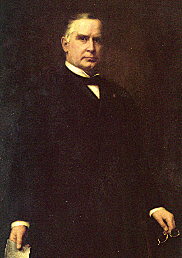
 |
UNDER CONSTRUCTION |
Maladies & Conditions
· memory · height · cried in office · the grippe · assassination
Odds & Ends ·
Doctors ·
Resources ·
Cited Sources
Maladies and Conditions

Boller
2a
says:
McKinley had a remarkable memory for faces and names... Once, while waiting for ceremonies to begin at the dedication of a monument at the Antietam battlefield, he walked over to the edge of the platform and called down to an old veteran in blue, "Hello, comrade, I saw you in the crowd at Gettysburg last month when I spoke there, didn't I?" Astonished, the veteran exclaimed, "Yes, but how did you recognize me?" Queried about his memory afterward, McKinley shrugged it off: "Oh, I don't know, it just comes naturally."

McKinley was 5 feet 7 inches tall, shorter than the average man. He was ridiculed as a "little
boy" when he ran for President in 1896
3.
Comment:
This is a clear illustration that politics always has been, and always will be, a nasty business.
McKinley's manhood should not have been open to challenge, given that he enlisted in the Army
at age 17, just weeks after the Civil War began at Ft. Sumter, and that he served in the
field virtually the entire war, including the battles of South Mountain, Antietam, Winchester,
Cedar Creek, and countless others
4a.


"At the beginning of the next season [1899?] a New Year's reception was held. After that
the President was taken sick with the grip [sic], and consequently all the receptions and dinner
parties were over for that season."
6a


McKinley was shot twice at close range on Sept. 6, 1901. One bullet bounced harmless off
his sternum and did not enter his body
1b.
The other entered the left upper quadrant of his abdomen, piercing the front and back
walls of the stomach
1c.
He underwent surgery within hours. He survived
the operation, but died on the ninth post-operative day. Both his post-operative course
MORE
7a
and his autopsy
MORE
7b
have been meticulously documented
8
9.
There was intense controversy about McKinley's medical care
MORE.
Some thought that McKinley could have been saved had renowned surgeon Roswell Park performed
the operation
MORE.
More recent commentators believe, however, that McKinley died from pancreatic necrosis, a condition
which is still difficult to treat today, and which the surgeons of McKinley's time could not
have treated or prevented
1.
Odds and Ends
- Like
James Polk,
and unlike
Woodrow Wilson,
McKinley paid great attention to his handshake. Boller notes
2b:
McKinley's handshake was famous. To save wear and tear on his right hand at receptions, the President developed what came to be called the "McKinley grip." In receiving lines, he would smile as a man came by, take his right hand and squeeze it warmly before his own hand got caught in a hard grip, hold the man's elbow with his left hand, and then swiftly pull him along and be ready to beam on the next guest. MORE
Pendel says 6b: "The President always took great delight in shaking hands with the people. He told one of the officials at the White House that he took more delight in shaking hands with the people than he did at one of the state dinners. It seemed to be a great gratification to him to meet the masses of the people." - Pendel 6c says: "President McKinley was a remarkable man; he was genial, a natural magnet. He drew the masses of the people to him. Always had a kind word, greeting with the extension of his hand every one that called on him, and endeavored to make them feel happy and at home."
- McKinley's wife, Ida, was subject to headaches and seizures. In order to attend to her, if necessary, McKinley broke tradition and sat next to her at official dinners. For example, one evening at dinner with William Taft, "a peculiar hissing sound" came from Mrs. McKinley. McKinley quickly picked up a napkin, dropped it over her face, and continued talking. Mrs. McKinley recovered a few moments later, and resumed her part in the conversation where she had left off 2c. To those around them, "They were a very happy man and wife" 6d.
- Seldes charges that editorials in the New York Journal inspired McKinley's assassin. He claims that "the only man in public life courageous enough to say so was Theodore Roosevelt." 10a
- As an attorney, McKinley once used of medicine's oldest techniques to win a malpractice suit brought against his client, a surgeon. MORE
- Army general Dr. Leonard Wood and surgeon general Dr. George Sternberg may have been McKinley presidential physicians before Rixey (see below). Dr. William Osler consulted on Mrs. McKinley. (I cannot now find where I read this. However, 11 quotes from Osler's own summary of 1901: "Two consultations at the White House and several Cabinet Ministers are responsible for a considerable increase in patients from the Capital." It is also possible that Osler was referring to Theodore Roosevelt's White House.)
- In June 1925, Dr. Presley M. Rixey, White House physician to both McKinley and Theodore Roosevelt, wrote an article called "Guarding the Health of Our Presidents" for a popular magazine called Better Health. Once accustomed to the author's ego, the article is an interesting narrative of a serious illness Mrs. McKinley suffered while traveling. It is also a reminder of the way antibiotics have changed the way humans live... and die. MORE 7c
Doctors
During Presidency
Assassination
- Presley Marion Rixey
- George McKenzie Hall
- Joseph Fowler
- Devillo W. Harrington
- Edward Wallace Lee
- Edward Cox Mann
- Matthew Derbyshire Mann
- Burton Thorne Simpson
- Herman Mynter
- Roswell Park
- John Parmenter
- Charles G. Stockton
- Willis D. Storer
- Peter W. Van Peyma
- Eugene Wasdin
- Eugene Wasdin
- Nelson Waltrow Wilson
- Edward Gamaliel Janeway
- William Waring Johnston
- Charles McBurney
Resources




Cited Sources
- Fisher, Jack. Stolen Glory: The McKinley Assassination. Alamar Books, 2001.
a p.60 b p. xii c p.77
- Boller, Paul F. Jr. Presidential Anecdotes. New York: Oxford University Press, 1981.
 a p.189 b p.188 c pp.189-190
- Page, Susan. Time-tested formulas suggest both Bush and Kerry will win on Nov. 2. USA Today. June 23, 2004.
Comment: Accessed through usatoday.com: http://www.usatoday.com/news/politicselections/nation/president/2004-06-23-bush-kerry-cover_x.htm - Halstead, Murat. The Illustrious Life of William McKinley, Our Martyred President. 1901.
a pp.114-121
- Butt, Archibald W. Taft and Roosevelt: The Intimate Letters of Archie Butt, Military Aide. Garden City, NY: Doubleday (1930). Volume 1: pages 1-432. Volume 2: pages 433-862.
a pp.733-734Comment: Butt, an Army officer, was military aide first to President Theodore Roosevelt and then to President William Taft. On April 14, 1912, Butt was at sea aboard the Titanic returning from a European vacation that Taft had insisted he take. President Taft later said: "When I heard that part of the ship's company had gone down, I gave up hope for the rescue of Major Butt, unless by accident. I knew that he would certainly remain on the ship's deck until every duty had been performed and every sacrifice made that properly fell on one charged, as he would feel himself charged, with responsibility for the rescue of others." Taft was correct. Butt did not survive the sinking.
- Pendel, Thomas F. Thirty-Six Years in the White House. Washington: Neale Publishing Company, 1902.
 a pp.156-157 b p.160 c p.166 d p.161Comment: Pendel was door-keeper at the White House from the time of Lincoln to the time of Theodore Roosevelt. Full text is available on-line at loc.gov. It is a rather dry book, and reads as if it were written by an old man. http://memory.loc.gov/cgi-bin/query/D?lhbcbbib:1:./temp/~~ammem_rEou::
- Braisted, William C.; Bell, William Hemphill; Rixey, Presley Marion. The Life Story of Presley Marion Rixey: Surgeon General, U. S. Navy 1902-1910: Biography and Autobiography. Strasburg, VA: Shenandoah Publishing House, Inc., 1930.
a pp.51-70 b pp.71-82 c pp.454-461Comment: Dr. Rixey was the White House physician for both William McKinley and Theodore Roosevelt.
- Rixey, PM; Mann, MD; Mynter, H; Park, R; Wasdin, E; McBurney, C; Stockton, CG. Death of President McKinley. J.A.M.A. 1901;37:779.
- Rixey, PM; Mann, MD; Mynter, H; Park, R; Wasdin, E; McBurney, C; Stockton, CG. The official report on the case of President McKinley. J.A.M.A. 1901;37:1029.
- Seldes, George. Witness to a Century. New York: Ballantine Books, 1987.
 a pp.28, 382
- Bensley EW, Bates DG. Sir William Osler's autobiographical notes. Bull Hist Med. 1976; 50: 596-618.
Other Sources
George Washington · John Adams · Thomas Jefferson · James Madison · James Monroe · John Q. Adams · Andrew Jackson · Martin van Buren · William Harrison · John Tyler · James Polk · Zachary Taylor · Millard Fillmore · Franklin Pierce · James Buchanan · Abraham Lincoln · Andrew Johnson · Ulysses Grant · Rutherford Hayes · James Garfield · Chester Arthur · Grover Cleveland · Benjamin Harrison · Grover Cleveland · William McKinley · Theodore Roosevelt · William Taft · Woodrow Wilson · Warren Harding · Calvin Coolidge · Herbert Hoover · Franklin Roosevelt · Harry Truman · Dwight Eisenhower · John Kennedy · Lyndon Johnson · Richard Nixon · Gerald Ford · James Carter · Ronald Reagan · George Bush · William Clinton · George W. Bush · Barack Obama · Donald Trump · Joseph Biden